WHEN WE WERE NORMAL
A Historical Augmented Reality Walking Tour
Who Controls the Student Paper?
LOCATION: Forthcoming

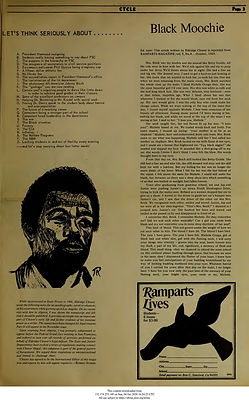
In 1969 during the fall semester at Fitchburg State College, President Hammond was sued by the students in charge of the school newspaper, led by its editor, John Antonelli. On September 21, 1969, the students submitted an issue of The Cycle that included Eldridge Cleaver’s “Black Moochie,” which was about sexuality and racism and included some profanity. The paper’s usual printer, Raymond Plante, objected to the theme and the four-letter words, refused to print it, and telephoned President Hammond. Hammond called the article “garbage” and refused to release the money for it. James J. Hammond then required that future issues be approved by an advisory board, and the students of the newspaper were upset and decided to file a lawsuit against James J. Hammond and the school administration.
In federal court in Boston, U.S. District Judge W. Arthur Garrity’s ruling on the case, issued February 5, 1970, was in favor of the students. The ruling was that there was no right by the school administration to editorial control of The Cycle and that the school administration failed to show instances where it would be necessary to take more restrictive measures than generally permitted under the First Amendment. The court found that the advisory board was prima facie an unconstitutional exercise of state power.
Here is the striking part. By the time of the trial, Hammond, apparently on his attorney’s advice, no longer argued that “Black Moochie” was obscene. The judge added a note that “in this he was correct.” The article that began the fight was one the administration could no longer defend as obscene.


The students still weren’t able to print “Black Moochie” with Hammond’s help, but instead got the Salem State University newspaper to print it for them. It wasn’t until 2019 that Fitchburg State University decided to print “The Black Moochie” because they felt not only was it important for students to read the story, but also let the staff writers know a little history of the newspaper and their old president.
In 2019, Fitchburg State University also marked the 50th anniversary of Antonelli v. Hammond with a public event remembering the case and its importance for student press freedom. Judge Garrity closed with a line that still carries weight. He wrote that “because of the potentially great social value of a free student voice in an age of student awareness and unrest, it would be inconsistent with the basic assumptions of First Amendment freedoms to permit a campus newspaper to be simply a vehicle for ideas the state or the college administration deems appropriate.”
Judge Garrity closed with a line that still carries weight. He wrote that “because of the potentially great social value of a free student voice in an age of student awareness and unrest, it would be inconsistent with the basic assumptions of First Amendment freedoms to permit a campus newspaper to be simply a vehicle for ideas the state or the college administration deems appropriate.”