WHEN WE WERE NORMAL
A Historical Augmented Reality Walking Tour
In November 1946, President Sanders (Dr. William J. Sanders) of State Teachers College, sent word to the military to get Roger back to Fitchburg because they needed him. They were training the next generation of teachers, and they thought: who would be better than Roger F. Holmes?
He was brought back from active duty and returned to the campus. He was 47 years old. He still remained connected to the Organized Reserve Corps through at least 1953, and his rank was still Lieutenant Colonel while he was teaching full-time at Fitchburg. During his time at Fitchburg, he wrote a manuscript titled, "Can We Educate for Democracy?” arguing that American schools had to provide honest instructions on competing social theories if they wanted to protect democratic values.
Roger F. Holmes, over the next two decades, served on the Administration Council and the Curriculum Committee. He held the position of Director of Graduate Study for years until he handed off those positions to Dr. John Nash in November 1968. In 1967, when he was 68 years old, he created a mandatory world history curriculum for all undergraduates. The idea of the program was to teach students to "interpret the world" through the liberal arts.
By February 1969, a student wrote to congratulate him on his retirement. Holmes was 69, and he had spent 30 years working at the college. On May 6, 1977, the Board of Trustees held a naming ceremony across campus. The dining hall was one of the buildings that needed a name. The dining hall, even though it had no name at first and was then given the nickname Daka, was officially named the Roger F. Holmes Dining Commons in recognition of his decades of service as a professor and a dean.

Teaching Democracy Behind Barbed Wire
LOCATION: Forthcoming


During World War II, Roger Franklin Holmes, a State Teacher’s College professor, left the college to teach democracy to Nazi prisoners, then came back to Fitchburg and spent 30 more years teaching the same thing to students.
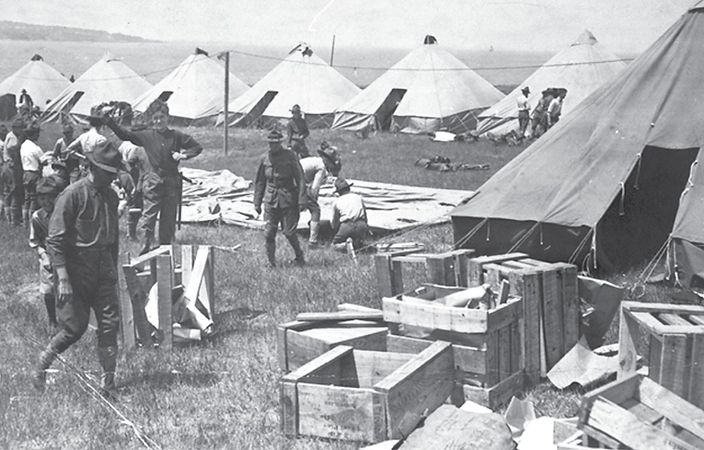
In the winter of 1945, somewhere inside the compound of Fort Getty, Rhode Island, 45-year-old Army Lieutenant Colonel Roger F. Holmes stood before a room full of German prisoners of war. His objective was to explain democracy, not as propaganda or as a lecture, but with a mission to be as educational as possible. He taught from the same material he taught in a Fitchburg classroom five years before that moment.
Holmes was born on April 7, 1899. When he joined the faculty of the State Teachers College at Fitchburg in January 1940, he was 40 years old. He received his B.A. from Wesleyan University, an M.Ed. from Boston University and his doctorate at Teachers College, Columbia University.
Roger was a professional at learning how other people learn and making sure he's the right teacher for the job. He taught psychology and educational methods, and he was also the director of teacher training before becoming the chairman of social studies. He was also really good at the piano, playing cello, and golf.
When the United States entered World War II, Holmes entered active military service on June 28, 1943, at the age of 44. With his credentials, the Army immediately assigned him as an instructor at elite military schools that included The Navy School of Military Government at Columbia University, The School of Military Government at Princeton, and The University of Chicago. At Columbia University, he taught army soldiers and lived in New York City. At Princeton, he was selected to help create a three-month long course in military government.
He rose from captain to major to lieutenant colonel. When he was appointed as the director of German Prisoner of War training schools at Fort Getty, Rhode Island, between 1945 and 1946, he re-educated German prisoners of war and taught them democracy.
This required him to be in a prison camp. Confidential records show Holmes writing memos to protect anti-Nazi prisoners. One example was a German named Heinz Heindorf. He advocated for him to be a free citizen. Holmes used these confidential channels to protect Heindorf, who was serving as an assistant instructor at the school. He warned that Heindorf's public opposition to Nazism put him in "danger of life and limb" if he were quartered with Nazi-aligned prisoners

